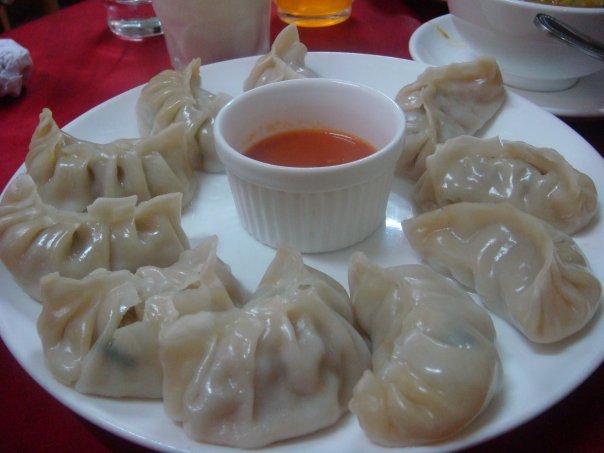
About Momo . . .
Buddhist practitioners of Shunyata (nothingness) believe that if you chant the word momo in low tones (mo...mo...mo...) repeatedly, it has the resonance of the universal 'Om' which spirals you towards shunyata or cosmic nothingness. And this is just the beginning. In Nepal, they love momos so much that, reports say, it's their unofficial national dish.
Momo is just the Tibetan name for dumpling. It's legends are plenty, sprinkled liberally over the history and heritage of several South-East Asian cultures. Like the Jiaozi (as the dumpling is called in China), before called Jiao'er, was apparently used to treat frostbitten ears. We wonder if that is the reason they are crescent shaped.
Closer home, India's northeastern belt has an enthusiastic momo eating population. The ancient Tibetan dish trickled through borders into tiny pockets of West Bengal (predominantly Darjeeling), Arunachal Pradesh, Assam and Meghalaya. In most of these states, momos, along with thukpa (a Tibetan broth) have become the most popular street dish. The minority Tibetan population introduced their fare of momos and thukpa to the indigenous residents.
The word momo has a certain rotundity to it. The sort that conjures up images of rosy-cheeked Tibetan and Nepali babies, strapped, with a piece of cloth, to their mothers' backs as they begin a steep climb. Or of the laughing Buddhas, whose bellies you rub for a stroke of luck. People belonging to the momo-eating cult have almost given it omnipotent powers. On a particular trip to Arunachal Pradesh, in the small town of Bomdila, I was introduced to the soul food at a roadside eatery. Hot bowls of vegetables and meat broth followed the pearly white momo balls. It was there that I was told that the momo qualifies as the best suited food for dhamma followers. In fact, it is a standing joke between the followers of Buddha, that the momo, father of dim sums, is the only likely platform that unites the Hinayana and Mahayana schools.
Legend has it that a rotund lama once demolished 32 momos at a single sitting after a particularly intense meditation session. Momos are a motley gathering of stuffings, often meat if you are Tibetan but with vegetarian options as well. They are placed on thinly rolled maida sheets and steamed like dim sums, pinched into fat rotund shapes or crescent moon shapes. Momos are not delicate like dim sum thicker portion of the dough is used to cover chunkier meat portions. This is hardy mountain fare to be consumed after a long day of meditation or back-breaking climbs on steep mountain roads.
Typically, momos are only made in the round, rotund shapes, patterned neatly into folds that cork the open mouth. They are, as a rule, eaten only steamed, but there are other preferred versions as well. These latter, then, are called dumplings.
I cruised through the city's dynamic dumpling-churning pits to discover places that do it justice. Eating a momo is a journey into mindfulness. I reflect on the goodness that is possible around us as I dip my steaming hot momo into a spicy tomato chutney and bite into its soft roundness. I wish all beings well as I sip the mildly spiced soup that accompanies the momos. I am aware of being warm and happy and for a moment wonder if 32 momos later, I will be ready for enlightenment. I hear a chuckle. Looking up, I sense that somewhere the Buddha is laughing.